Why "belly fat" doesn't go away — even when you're losing weight
And what the trainer's phrase "it's all diet now" actually means. It sounds like an excuse, but physiologically it's almost perfectly accurate.
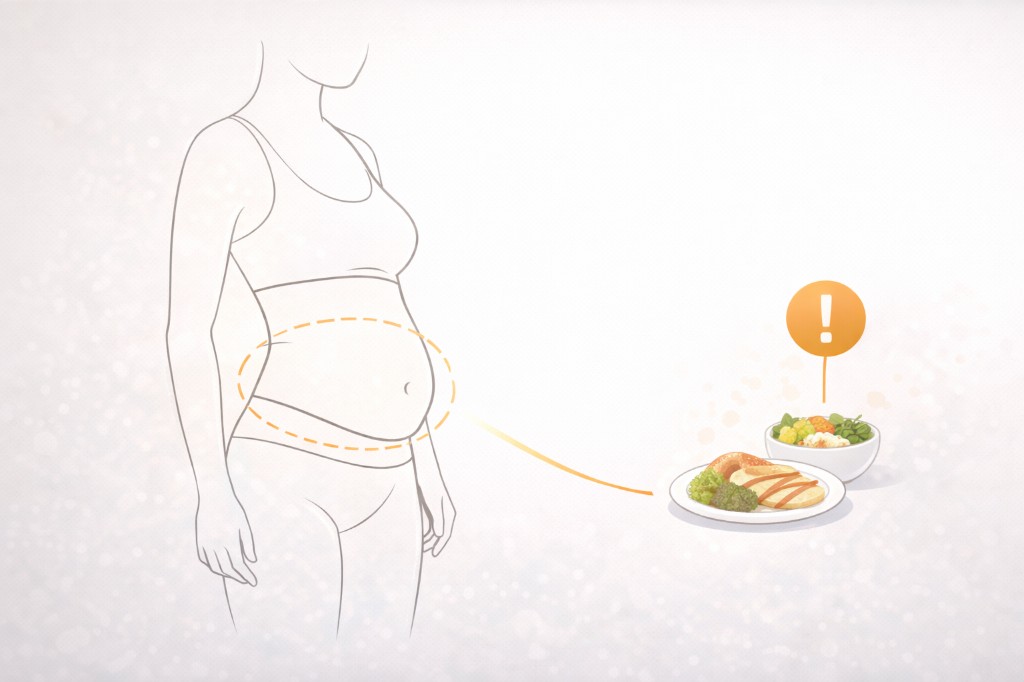
There is a moment almost every person losing weight experiences.
You already see results: arms are thinner, hips — smaller, face — sharper. But the waist stubbornly stands still.
You point to your belly and ask the trainer:
— What to do with this?
And hear in response:
— It's already nutrition.
Sounds a bit like dodging the answer. But from a physiological point of view, this is an almost perfectly accurate phrase.
Let's figure it out.
Myth #1: You can "burn belly fat" by doing crunches
This is one of the most persistent fitness legends.
The logic is clear: train muscle → fat above it disappears.
But the body works differently.
When the body starts using fat as fuel, it doesn't choose a specific area. Fatty acids enter the bloodstream and are used systemically.
Note:
That means the body decides where to take energy from.
Even very intensive ab exercises do not guarantee belly fat reduction.
In a classic study, participants performed abdominal exercises for 6 weeks — this improved muscular endurance, but did not reduce abdominal fat.
https://pubmed.ncbi.nlm.nih.gov/21804427/
Most scientific reviews come to the same conclusion: spot reduction is practically ineffective as a strategy.
And yes — this is bad news for those who hate planks 🙂
So what does "it's already nutrition" mean?
Translated from "trainer-speak", it means three things:
1️⃣ Stable energy deficit is needed
Fat disappears only when the body is forced to use reserves. Without this — no training protocol will save you.
2️⃣ Biology determines fat distribution
It is influenced by: genetics, hormones, age, weight fluctuation history, stress levels, sleep.
That is why two people with the same fat percentage can look completely different.
3️⃣ The belly is the body's "favorite warehouse"
The abdominal area is metabolically active and often used as a strategic energy reserve.
So yes, very often it "holds on" until the last moment.
It's not a bug. It's a feature (design).
Why waist might stall while weight drops
This is a moment that breaks the psyche of many people — and absolutely in vain.
Here are the most common reasons.
Uneven fat loss is normal
The body doesn't lose weight "symmetrically". Some zones are genetically more sensitive to fat mobilization, others — more stubborn. For women, these are often the lower belly, sides, and back of thighs.
Age and hormonal changes are reality, not an excuse
With age, the female body tends to redistribute fat towards the abdominal area — partly due to changes in estrogen levels.
https://pmc.ncbi.nlm.nih.gov/articles/PMC9258798/This doesn't mean shape cannot be changed. It only means one thing: the same methods that worked in your 20s might be insufficient in your 30s+. And that's normal.
It might not be fat
The belly is the area with the most visual fluctuations. Sometimes "fat" is: fluid retention, bloating, reaction to salt/carbs, menstrual cycle phase, digestion issues. That's why the waist is one of the least stable anthropometric metrics.
You are losing weight, but unconsciously moving less
This is called metabolic adaptation of behavior. On a deficit, people: gesture less, stand up less often, walk slower, sit more. And the deficit partially disappears.
No joke — sometimes 8–10 thousand steps do more for the waist than one extra workout.
The most important question: Should you "squeeze out" the last fat?
Here begins an adult conversation about health.
Sometimes, to get a maximally flat stomach, a woman needs to enter very low energy availability.
And this can affect: menstrual cycle, hormonal balance, bone tissue, mood, energy levels.
This state is described in medicine as low energy availability.
https://www.endocrine.org/-/media/endocrine/files/cpg/fha-cpg-resource-page-13feb18.pdf
Therefore, the truth sounds like this:
In some cases, "the last centimeters of waist" may indeed be incompatible with long-term female health.
And then the question changes. Not "how to remove the belly", but: is it worth the price?
What really works (no fitness magic)
Ensure the deficit exists
Not "it seems so", but it exists. 2–4 weeks of honest tracking give more answers than any trainer.
(Yes, Calorize is literally created for this 🙂)
Improve food quality
More: protein, fiber, whole foods. Less: ultra-processed food, liquid calories. It's not about "purity". It's about appetite control.
Strength training — underestimated hero
They don't burn fat locally. But they help: maintain muscles, improve body composition, counteract age-related abdominal accumulation.
https://www.sciencedirect.com/science/article/pii/S0378512223004000Simply put: at the same weight, the body looks much "leaner".
Walk more than you think you need
NEAT is one of the strongest and most underestimated fat burning factors. And the most pleasant 🙂
Look at waist as a health metric
Waist circumference is used in medicine as a marker of cardiometabolic risk.
https://pmc.ncbi.nlm.nih.gov/articles/PMC7027970/Meaning, it's not just about aesthetics.
Conclusion
When a trainer says "it's already nutrition", they are actually saying:
- Belly fat will go only when the body generally continues to lose fat.
- Exercises cannot choose the area.
- Fat distribution is biology, not your mistake.
And, perhaps, the most important thing:
An ideal waist is not always the same as a healthy body.
Sometimes the real victory is finding the point where form, hormones, energy, and psyche are in balance. And not driving yourself to exhaustion for the sake of another minus two centimeters.