Why Most Fitness Coaches Are Wrong (Not Out of Malice)
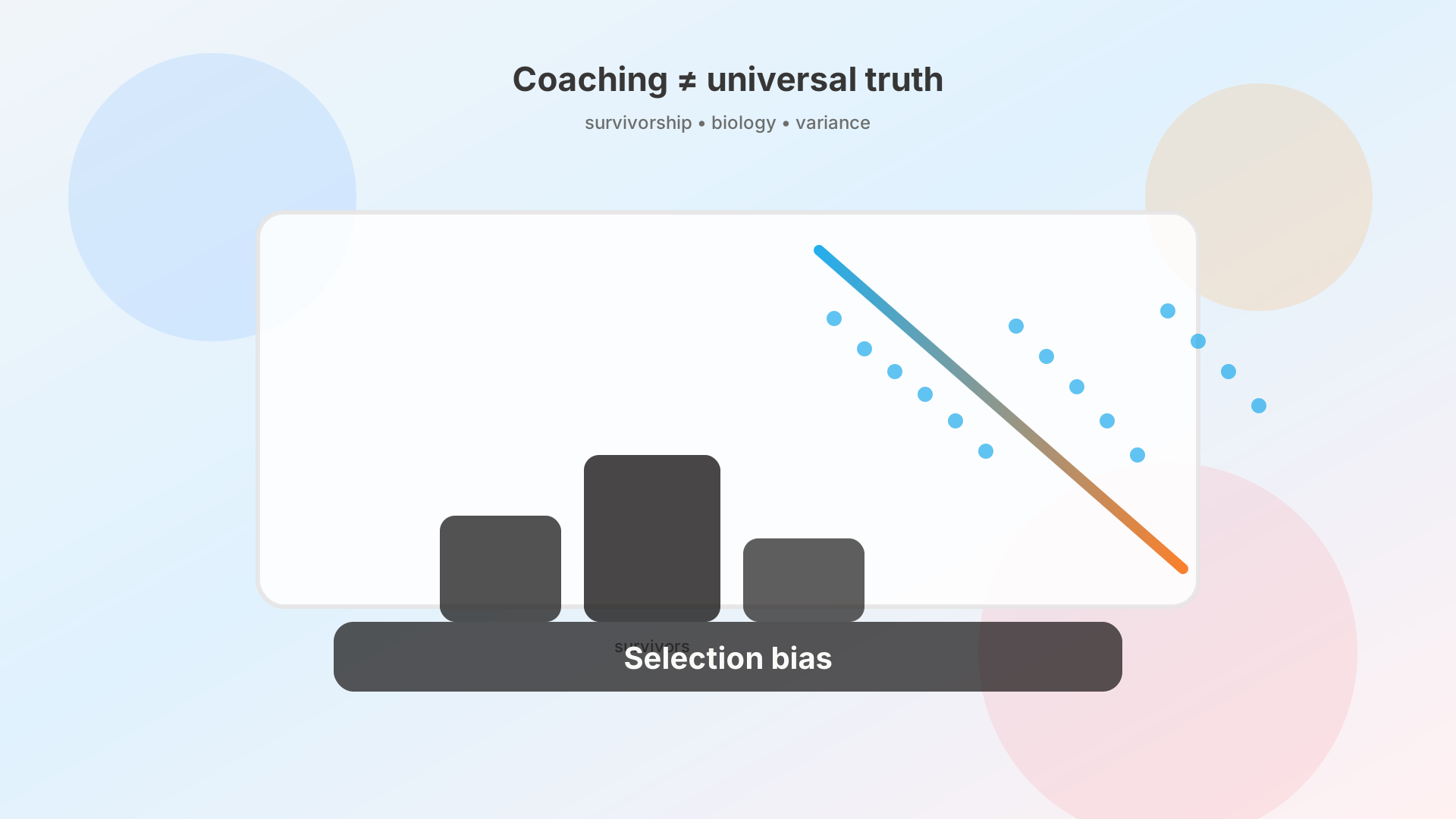
The fitness and “clean eating” industry is built on selection bias. Most coaches never experienced true obesity, metabolic adaptation, or rebound cycles. They truly believe in their model—but that model does not scale to most people.
Abstract
In popular discourse, fitness coaches present weight loss as a simple process driven by discipline and “good habits”. But long-term data show stable weight maintenance is a rare exception, not the typical outcome.
This article explains how selection bias, survivorship bias, and genetic variability create a distorted picture of “success” in the weight-loss industry—and why many coaches are wrong not out of bad intent, but due to their own biological luck.
Key Points
1) Selection Bias: You Are Looking at the Wrong People
Social feeds are full of success stories: “I lost 30 kg”, “I changed my life”, “I just started eating right”.
You do not see the hundreds who did the same—and regained weight 2–5 years later.
This is classic survivorship bias: only those for whom it worked (by chance or biology) remain visible. [1]
And those visible outliers often become coaches—not because they have a universal formula, but because they are a rare exception.
2) Many Never Lived Through True Obesity
If you look closely at the background of many coaches, a pattern appears:
- they were “a bit chubby” in childhood
- or they were always lean
- or they had a short weight-gain phase
- but they never lived for years with obesity
This matters because people without obesity history often do not experience the same biological pressure: metabolic adaptation, defended weight shifts, chronic appetite elevation, rebound cycles.
So they genuinely do not understand why “just eat less” fails for others.
3) Genetic Luck Often Gets Labeled “Discipline”
Twin studies suggest heritability explains a large share (often 40–70%) of body-weight variability. [3]
That means some people naturally have lower appetite, higher energy expenditure, weaker compensation to restriction, and more stable satiety signals.
When such a person loses weight, they may sincerely believe it was purely willpower. Often it is biology plus survivorship bias.
4) Why Their Advice Does Not Scale
A coach sees 10 clients. Two succeed. Eight do not.
A common (wrong) conclusion is: “the two were disciplined, the rest were lazy”.
In reality, those groups can differ in biology: dieting history, defended weight, appetite pressure, and the strength of metabolic adaptation.
Long-term evidence shows most people do not maintain weight loss. [2]
So the model does not scale. It may work for a minority, but it fails for the majority.
5) Moralizing Weight Is Pseudoscience
When a coach says “you just are not trying hard enough”, that is not motivation—it is bad science.
Hormonal and metabolic adaptations after weight loss can persist for years. [4]
That means someone can do “everything right” and still struggle to lose or maintain weight.
Calling this “lack of discipline” is ignoring biology.
6) Why Many Coaches Truly Do Not See It
Most fitness coaches are not malicious manipulators. They often:
- have their own success story
- see a few successful clients
- do not see those who quit and disappear
- lack the biological contrast
The brain draws a natural conclusion: “it worked, so it is universal”. That is not malice—it is a cognitive bias.
7) What To Do Instead
The solution is not to “cancel fitness”. The solution is to:
- stop selling universal formulas
- stop moralizing weight
- acknowledge biological diversity
- individualize strategies
And stop implying that if it did not work, something is wrong with the person.
Conclusions
- 1The fitness industry is shaped by survivorship bias.
- 2Most coaches do not know what true obesity feels like.
- 3Their success does not reliably scale.
- 4Genetics often masquerades as discipline.
- 5Moralizing weight is pseudoscience.
Practical Implications (Not Medical Advice)
- If coach advice does not work for you, the problem is not necessarily you.
- Comparing yourself to outliers is a methodological error.
- There are no universal strategies.
- Individualization is the only scientifically sound model.
References
- 1 Ioannidis JPA. (2005). Why most published research findings are false. PLOS Medicine, 2(8): e124. doi:10.1371/journal.pmed.0020124. PubMed
- 2 Mann T, Tomiyama AJ, Westling E, et al. (2007). Medicare's search for effective obesity treatments: Diets are not the answer. American Psychologist, 62(3):220–233. doi:10.1037/0003-066X.62.3.220. PubMed
- 3 Wardle J, Carnell S, Haworth CMA, Plomin R. (2008). Evidence for a strong genetic influence on childhood adiposity. International Journal of Obesity, 32:398–404. doi:10.1038/sj.ijo.0803724. PubMed
- 4 Fothergill E, Guo J, Howard L, et al. (2016). Persistent metabolic adaptation 6 years after “The Biggest Loser” competition. Obesity, 24(8):1612–1619. doi:10.1002/oby.21538. PubMed