Food Cravings and "Food Noise": Why These Are Real Mechanisms, Not Fiction
For some people, food is not just calories — it is a constant background process in the brain. Science shows this is neurobiology, not a character flaw.
In weight discussions, a simple formula often comes up: "Just eat less."
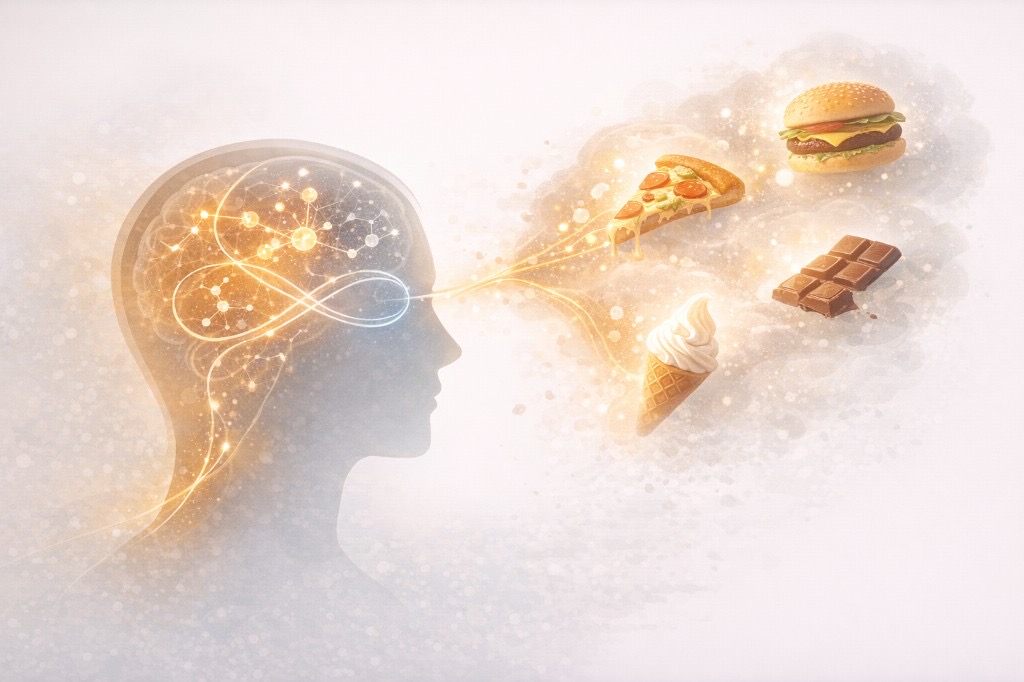
The problem is that for some people food is not just calorie intake. It is a constant background process in the brain.
Food cravings are intense, specific desires for particular foods. Food noise is a persistent inner "hum" of thoughts about food.
These phenomena are hard to measure with a ruler. And anything hard to measure is easy to dismiss.
But modern science shows: this is not a matter of weak character.
What food cravings actually are
A craving is not just "I kinda want something sweet."
In research, cravings are described as:
- an intense desire for a specific food
- intrusive thoughts about it
- an emotional component (anticipation of reward)
Cravings are linked to the brain's reward system — specifically dopamine pathways. [1]
Functional MRI shows that food cues activate brain areas associated with motivation and reward, similar to other powerful stimuli. [2]
This is neurobiology, not "weak willpower".
What food noise is
Food noise is a term popular on social media, but it describes a real phenomenon:
- a constant background monologue about food
- planning the next meal
- repetitive "can I / can't I" thoughts
- difficulty "switching off" the topic of food
In scientific terms, this sits at the intersection of appetite regulation (leptin, ghrelin), cognitive control, and the reward system.
After weight loss, ghrelin (hunger hormone) rises and leptin drops — and this can persist for a long time. [3]
This means that for some people, the biological hunger signal becomes stronger even after they have already reached a lower weight.
Why for some it is background, and for others — constant noise
People differ in:
- leptin sensitivity
- dopamine system reactivity
- tendency toward intrusive thoughts
- inherited appetite traits
Genetic variants (including FTO) are associated with higher energy intake and greater hunger. [4]
BMI heritability is estimated at 40-70%. [5]
So the baseline "noise level" can vary from person to person.
Why "just control yourself" does not work for everyone
In theory, a person can control their eating. Just like they can hold their breath.
But control does not equal sustainability.
After weight loss, the body increases hunger, reduces energy expenditure, and amplifies food motivation.
This is metabolic adaptation. [6]
A person can restrain themselves. But they have to do it against amplified biological signals.
For some, this is a background difficulty. For others — a daily battle.
Why this becomes a zone of shaming
Food noise cannot be seen on lab results. It cannot be measured with a tape measure.
That is why it is often interpreted as lack of discipline, emotional weakness, or "just laziness".
But the neurobiology of appetite is one of the most complex regulatory systems in the body. And it is not the same for everyone.
Why reducing food noise is possible
Pharmacological studies of GLP-1 agonists show that influencing hormonal appetite regulation can reduce not only calorie intake, but also the intrusiveness of food-related thoughts. [7]
This is yet another indirect proof that "food noise" has a biological basis.
Conclusion
Food cravings and food noise are not fiction.
They are a combination of hormonal regulation, reward system activity, genetic traits, and environment.
This does not remove responsibility for behavior. But it removes oversimplification.
Because different people start with different volumes of this "inner noise".
References
- 1 Volkow ND, Wang GJ, Baler RD. Reward, dopamine and the control of food intake. Trends in Cognitive Sciences. https://pubmed.ncbi.nlm.nih.gov/21067975/
- 2 Pursey KM, et al. Neural responses to visual food cues according to weight status. Frontiers in Nutrition. https://pubmed.ncbi.nlm.nih.gov/26041903/
- 3 Sumithran P, et al. Long-term persistence of hormonal adaptations to weight loss. New England Journal of Medicine. https://pubmed.ncbi.nlm.nih.gov/22029981/
- 4 Frayling TM, et al. FTO gene and obesity. Science. https://pubmed.ncbi.nlm.nih.gov/17434869/
- 5 Locke AE, et al. Genetic studies of BMI. Nature. https://pubmed.ncbi.nlm.nih.gov/25673413/
- 6 Rosenbaum M, Leibel RL. Adaptive thermogenesis in humans. International Journal of Obesity. https://pubmed.ncbi.nlm.nih.gov/20531349/
- 7 Wilding JPH, et al. Semaglutide in obesity. New England Journal of Medicine. https://pubmed.ncbi.nlm.nih.gov/33567185/