How to Reconstitute and Inject Tirzepatide, Semaglutide (Ozempic / Mounjaro) and Other Peptides:
Step-by-Step Guide
Bought a vial of powder and wondering what to do next? This guide explains everything in plain language — no medical jargon needed.
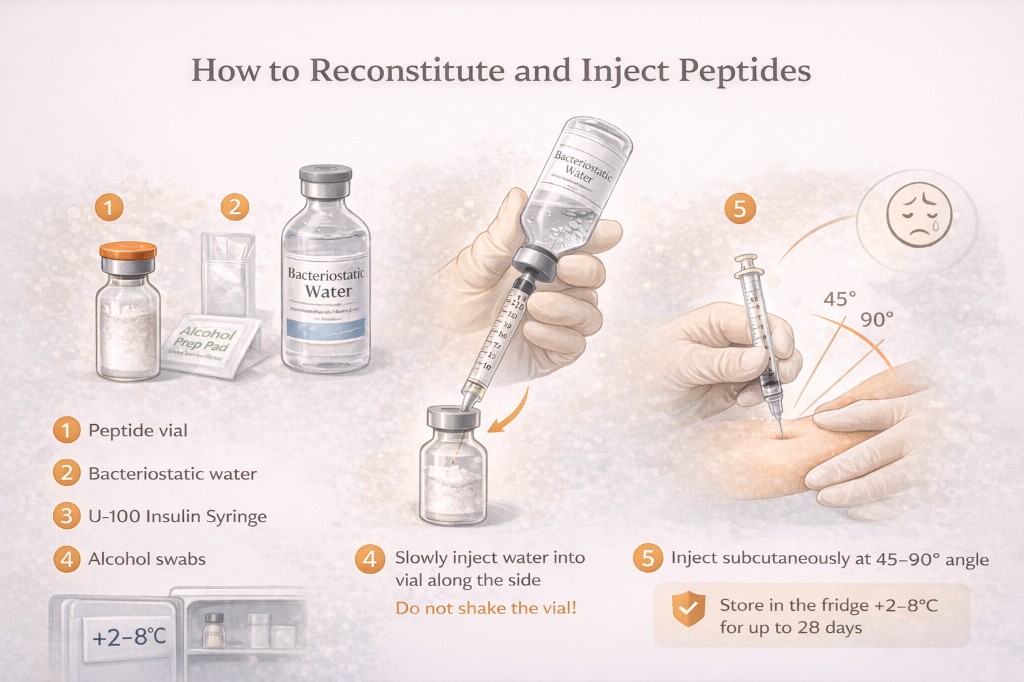
Tirzepatide and Semaglutide in powder form are the same active ingredients found in brand-name medications like Mounjaro and Ozempic. The difference is that the branded pens come pre-mixed and are ready to use, while the generic peptide powder needs to be reconstituted (mixed with sterile water) before each injection cycle.
This guide covers the full process: what you need, how to mix, how much water to use, how to inject, and how to store the solution.
1. What you need for an injection
Before you start, prepare these 4 things:
- 1 Peptide vial — the dry powder (Tirzepatide, Semaglutide, BPC-157, etc.)
- 2 Bacteriostatic water (BW) — sterile water with 0.9% benzyl alcohol that keeps the solution safe in the fridge for up to 28 days. Do not use regular tap water or saline.
- 3 Insulin syringe U-100 — a standard 1 ml insulin syringe with 100 units per ml. The thin needle also minimises discomfort.
- 4 Alcohol wipes — to clean the tops of both vials before inserting the needle.
2. How to reconstitute Tirzepatide and Semaglutide
Follow these steps in order. Take your time — there is no rush.
-
1
Clean both vial tops with an alcohol wipe.
Wipe the rubber stopper on both the peptide vial and the bacteriostatic water vial.
-
2
Draw air into the syringe equal to the water volume you need.
For example, if you need 1 ml of water, pull the plunger back to the 100-unit (1 ml) mark while the syringe is empty.
-
3
Inject this air into the bacteriostatic water vial, then draw out the water.
The air pressure makes drawing easier. Flip the vial upside down and pull out the required volume.
-
4
Inject the water slowly into the peptide vial — along the inner wall, not directly onto the powder.
Angle the needle so the water runs down the glass side. This protects the peptide structure.
-
5
Do NOT shake the vial.
Shaking degrades the peptide. Instead, gently roll the vial between your palms for 20–30 seconds, or leave it for a couple of minutes to dissolve on its own.
-
6
The solution should be clear.
A clear, colourless liquid means it is ready. If it looks cloudy or has visible particles, do not use it.
3. How much water to add to the vial?
The amount of water determines the concentration — and therefore how many units you draw for each dose.
The most common approach:
- 1 ml water in a 5 mg vial → 5 mg/ml (5000 mcg/ml)
- 2 ml water in a 5 mg vial → 2.5 mg/ml (2500 mcg/ml)
- 1 ml water in a 2 mg Semaglutide vial → 2 mg/ml — a 0.5 mg dose = 25 units (U-100)
The exact units to draw depend on your vial size, the water volume, and your dose. This is why a calculator is essential.
Do not guess — use the calculator
Enter your vial size, water volume, and dose. Get the exact number of units to draw, instantly.
4. How to inject peptides into the abdomen
Subcutaneous injections go into the fat layer just below the skin — the abdomen (belly) is the most common and convenient site.
-
1
Choose the site.
Inject 5–10 cm away from the navel. Avoid the belly button itself and any bruised or irritated skin.
-
2
Pinch the skin gently.
Use your thumb and index finger to lift a small fold of skin and fat.
-
3
Insert the needle at a 45–90° angle.
Thinner people use 45°; more body fat means you can go 90°. Push in with a quick, confident motion.
-
4
Inject slowly.
Push the plunger down steadily over 5–10 seconds. A slow injection is less painful.
-
5
Rotate injection sites.
Move at least 2 cm from the previous site each time. Repeated injections in the same spot cause lumps (lipohypertrophy) and reduce absorption.
5. How to store the reconstituted vial
After mixing, the reconstituted solution must be stored properly to stay effective.
- Temperature: refrigerator at +2°C to +8°C. Never freeze.
- Duration: up to 28 days with bacteriostatic water. Mark the date on the vial.
- Light: protect from light. Keep the vial in its box or wrap it in foil.
- Dry powder (unreconstituted): can be kept at room temperature for up to 3 months, or in the fridge for up to 2 years.
Quick reference
| Step | Key rule |
|---|---|
| Mixing | Water along the wall, do not shake |
| Water amount | 1–2 ml typical, check with calculator |
| Injection | Pinch skin, 45–90°, inject slowly |
| Storage | Fridge 2–8°C, max 28 days, no freezing |