Increased Appetite: Normal Variation or Sign of Disease?
When someone eats a lot or constantly feels hungry, the first suggestions are: "check your thyroid", "it's nerves", "it's depression". Sometimes true. But not always. The key is knowing the difference.
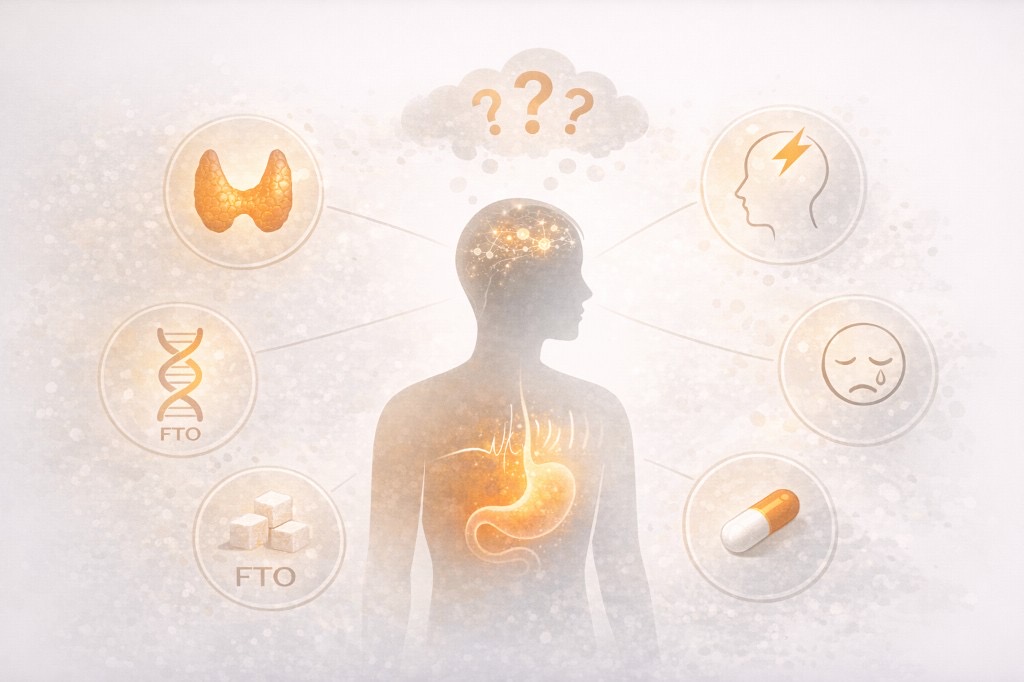
1. Appetite as biological variation
Appetite regulation is one of the most complex systems in the body.
It includes:
- hormones (leptin, ghrelin, insulin)
- hypothalamus
- reward system (dopamine pathways)
- cognitive control
People differ in their sensitivity to these signals.
Genetic contribution
BMI heritability is estimated at approximately 40-70%. [1][2]
This means baseline appetite and response to food are partly genetically determined.
FTO gene variants are associated with higher energy intake and stronger hunger sensations. [3]
"Big appetite" can be a normal variant, not a malfunction.
2. Food cravings and "food noise"
Intense food desires (cravings) and constant background "food noise" have a neurobiological foundation.
Brain imaging shows that food cues activate areas linked to the reward system. [4]
After weight loss, ghrelin rises and leptin falls — and these changes can persist long-term. [5]
This means that for some people, the biological hunger signal is objectively stronger.
Control is possible. But its difficulty varies from person to person.
3. When increased appetite is a normal variant
It is more likely biological variation if:
- appetite has been stable since childhood
- similar traits run in the family
- there is no sudden change in state
- no other symptoms are present
In this case, it may be an individual feature of appetite regulation.
This does not mean weight control is easy. But it does not necessarily mean pathology.
4. When appetite can be a symptom
There are conditions where increased appetite is a clinical sign.
Hyperthyroidism
With excess thyroid activity:
- basal metabolism increases
- appetite intensifies
- weight loss is possible
- tremor, tachycardia, sweating appear
Glycemia disturbances
Sharp glucose swings can trigger frequent hunger, post-meal drowsiness, and cravings for fast carbs. [7]
Medications
Rare conditions
Hypothalamic disorders or other neurological lesions can affect appetite regulation. But such causes represent a small percentage of cases.
5. Why stigmatization occurs
Increased appetite cannot be seen on a blood test.
So it is often interpreted as lack of discipline, psychological weakness, or "just overeating".
This is oversimplification.
Appetite regulation is a neuroendocrine process, not a moral category.
6. Should appetite be "fixed"?
Not always.
If increased appetite:
- is not accompanied by other symptoms
- does not threaten health
- is not a sudden change
— it may be a variant of individual norm.
But modern medicine also allows influencing appetite regulation if a person chooses this for health or quality of life reasons. [9]
The key is informed choice, not stigma.
Conclusion
Increased appetite is not always a disease. But sometimes it is a symptom.
The difference between normal variation and pathology lies in:
- suddenness of changes
- presence of accompanying symptoms
- medical context
Most importantly: appetite is not a moral characteristic of a person. It is a biological process with large individual variability.
References
- 1 Bouchard C. Genetics of obesity in humans. New England Journal of Medicine. https://pubmed.ncbi.nlm.nih.gov/9314854/
- 2 Locke AE, et al. Genetic studies of BMI. Nature. https://pubmed.ncbi.nlm.nih.gov/25673413/
- 3 Frayling TM, et al. FTO gene and obesity. Science. https://pubmed.ncbi.nlm.nih.gov/17434869/
- 4 Volkow ND, et al. Reward, dopamine and the control of food intake. Trends in Cognitive Sciences. https://pubmed.ncbi.nlm.nih.gov/21067975/
- 5 Sumithran P, et al. Long-term persistence of hormonal adaptations to weight loss. New England Journal of Medicine. https://pubmed.ncbi.nlm.nih.gov/22029981/
- 6 Ross DS, et al. 2016 American Thyroid Association Guidelines for Hyperthyroidism. https://pubmed.ncbi.nlm.nih.gov/27521067/
- 7 Ludwig DS. The glycemic index: physiological mechanisms. JAMA. https://pubmed.ncbi.nlm.nih.gov/10219050/
- 8 Allison DB, et al. Antipsychotic-induced weight gain. https://pubmed.ncbi.nlm.nih.gov/11013376/
- 9 Wilding JPH, et al. Semaglutide in obesity. New England Journal of Medicine. https://pubmed.ncbi.nlm.nih.gov/33567185/