Set Point: Why Weight Stalls and Why the Body Resists Weight Loss
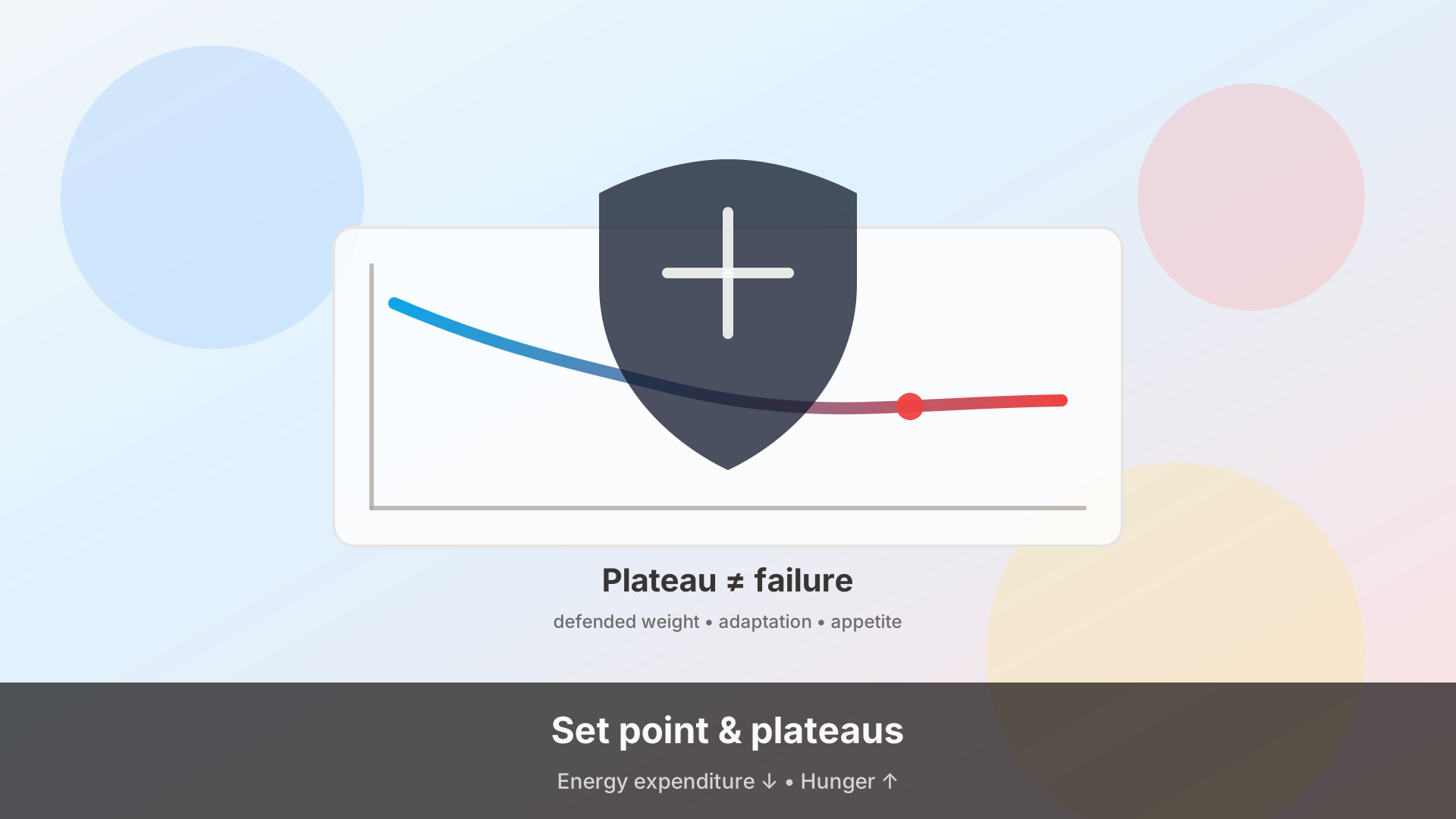
If your weight does not move for months despite a calorie deficit and training, it is not always a tracking mistake or sabotage. The body may defend a higher weight by lowering energy expenditure and increasing appetite to return to what it considers safe.
Abstract
Many people face a plateau: weight stops decreasing even when a calorie deficit and regular activity are maintained.
Popular explanations focus on tracking errors or motivation. However, research shows plateaus can reflect active neuroendocrine and metabolic adaptations aimed at protecting body mass after weight loss.
This article takes a practical look at the set point (defended weight) concept, explains why the body resists further loss, and why plateaus are common and not necessarily pathological.
Key Points
- After weight loss, the body can actively defend the previous weight. [1]
- Metabolism can slow down more than formulas would predict. [2]
- Appetite can increase even when calorie targets stay the same. [1]
- A plateau is often a phase of biological adaptation, not a process failure. [3]
- Not every body can easily “reset” the defended weight range. [3], [4]
1) What Set Point Means in Plain Language
Modern research often uses defended weight or settling point instead of a rigid set point. The idea is similar: the body has a weight range it considers safe and will try to return to it after weight loss.
When you lose weight, the brain does not interpret it as “better shape”. It can interpret fat loss as a threat and trigger compensations:
- higher appetite
- weaker satiety signals
- slower metabolism
- less spontaneous daily movement (NEAT)
This is not “broken metabolism”. It is an evolutionary energy defense system. [3]
2) Why Weight Stalls Even If You Eat “Little”
A common complaint sounds like: “I eat 1200–1500 kcal, I train, and my weight does not move for weeks or months.”
From a scientific point of view, there are several reasons:
- Adaptive thermogenesis. After weight loss, resting energy expenditure can drop more than expected from body mass change alone. [2]
- Lower NEAT. The body can unconsciously reduce spontaneous activity outside training, lowering total daily expenditure. [3]
- Higher appetite. Even if the planned calorie target does not change, hunger signals can increase and make the real deficit harder to maintain. [1]
As a result, the actual energy deficit can disappear even if the plan looks unchanged on paper.
3) Why a Plateau Is Not the End of the Process
A plateau often feels like proof that the method stopped working. In reality, it can be a period when the body is rebuilding a new energy balance.
At the same time, scale weight is noisy: glycogen, water retention, bowel content, and training inflammation can mask fat loss for weeks.
Plateaus are a signal to adjust strategy, not a moral verdict. The goal is to reduce hunger pressure and keep the deficit realistic and sustainable.
4) What to Do During a Plateau (Practical Checklist)
- Track trends, not single weigh-ins (use a 7–14 day trend line).
- Audit intake for 7 days (hidden calories, oils, snacks, drinks).
- Raise protein and fiber to improve satiety.
- Increase steps/NEAT (a small daily increase can matter).
- Consider a 1–2 week maintenance phase if hunger is high and adherence is collapsing.
- Prioritize sleep and stress reduction (both affect appetite).
Conclusions
- 1A plateau is common after weight loss and often reflects adaptation.
- 2The body can defend weight by lowering expenditure and increasing hunger.
- 3NEAT and metabolic adaptation can reduce the expected deficit.
- 4Plateaus are best handled by strategy adjustments, not extreme restriction.
- 5If plateaus are persistent, professional support and medical evaluation can help.
Practical Implications (Not Medical Advice)
- If weight is stuck, it does not automatically mean you are doing something wrong.
- Aim for a sustainable deficit and build skills for maintenance phases.
- If hunger is overwhelming, discuss evidence-based tools with a clinician (including medication when appropriate).
References
- 1 Sumithran P, Prendergast LA, Delbridge E, et al. (2011). Long-term persistence of hormonal adaptations to weight loss. New England Journal of Medicine, 365:1597–1604. doi:10.1056/NEJMoa1105816.
- 2 Fothergill E, Guo J, Howard L, et al. (2016). Persistent metabolic adaptation 6 years after “The Biggest Loser” competition. Obesity, 24(8):1612–1619. doi:10.1002/oby.21538.
- 3 Westerterp KR. (2018). Exercise, energy balance and body composition. European Journal of Clinical Nutrition (review). doi:10.1038/s41430-018-0180-4.
- 4 Hall KD, Kahan S. (2018). Maintenance of lost weight and long-term management of obesity. Medical Clinics of North America, 102(1):183–197. doi:10.1016/j.mcna.2017.08.012.