Willpower Is a Myth: Who Really Controls Your Appetite
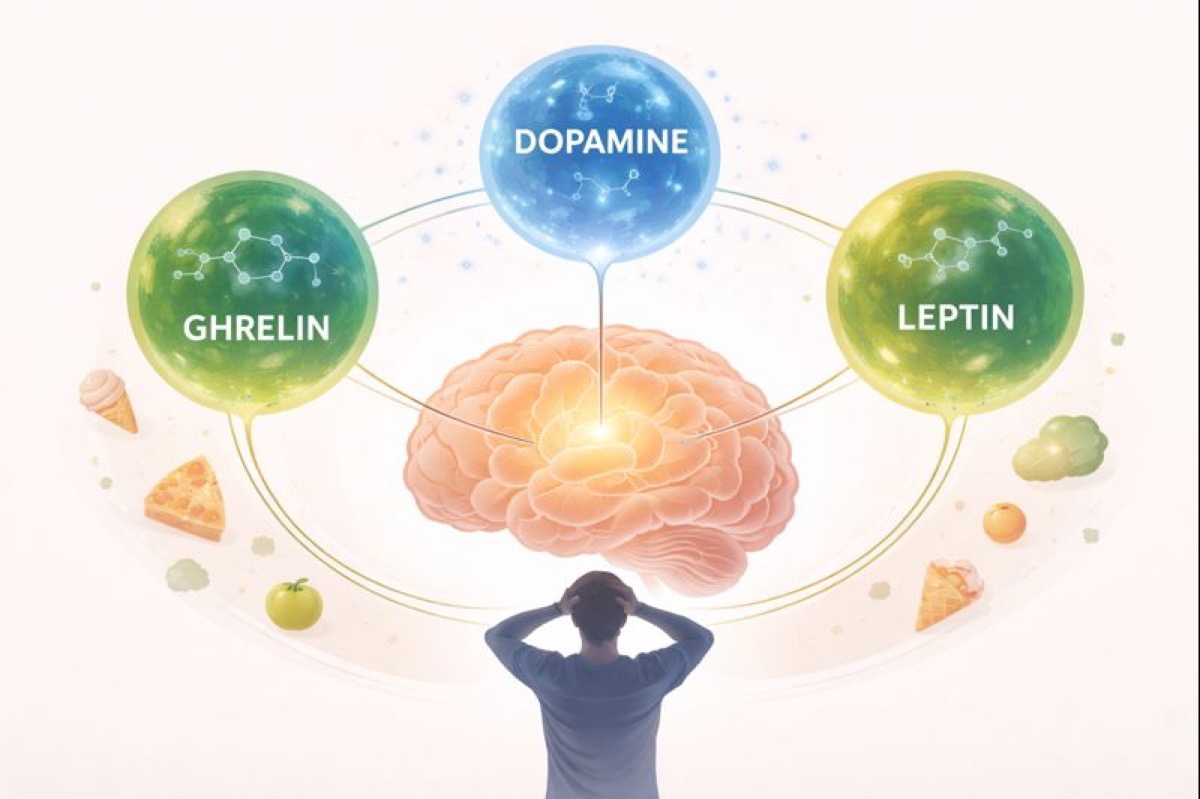
Appetite is not a reflection of character or discipline. It is regulated by a complex neuroendocrine system where hormones, the hypothalamus, and dopamine circuits play central roles. When people “break” on diets, it is often a predictable biological adaptation—not weakness.
Abstract
Popular culture explains overeating as a lack of willpower. Modern neuroscience suggests appetite is shaped by the interaction of hypothalamic centers, peripheral hormones, and the brain reward system.
After restriction or weight loss, these systems adapt in ways that increase hunger, reduce satiety signals, and raise dopamine reactivity to food.
This article reviews key appetite regulation mechanisms and explains why long-term “control” is a biologically limited resource, not an endless moral quality.
Key Points
- Appetite is regulated by the hypothalamus and hormones—not by “character”. [1]
- Ghrelin and leptin shift after diets in a direction that increases hunger. [2]
- The brain reward system makes food a powerful dopamine stimulus. [3]
- After weight loss, the brain can become more sensitive to food cues. [2]
- Willpower cannot compensate for these neurobiological shifts long-term. [1], [4]
1) Hypothalamus: The Appetite Dispatcher
At the center of appetite regulation is the hypothalamus—a small but critical brain structure. It integrates signals from peripheral hormones (ghrelin, leptin, insulin, PYY) and generates hunger or satiety commands.
Two key hypothalamic neuron populations have opposite roles: some promote eating (NPY/AgRP) while others suppress it (POMC/CART). The balance between these systems strongly shapes whether a person feels hungry or full. [1]
When this balance shifts toward hunger, motivation cannot fully cancel it out. This is a direct neural drive to act, not a psychological whim.
2) Hunger and Satiety Hormones
Appetite is not just “in the moment”—it reflects long-term hormonal dynamics. Two key players are ghrelin and leptin.
Ghrelin is produced in the stomach and signals the brain that food is needed. It rises before meals and can increase after restriction.
Leptin is produced by fat tissue and suppresses appetite. After weight loss, leptin drops, and the brain interprets it as a threat to energy reserves.
A classic New England Journal of Medicine study showed that after weight loss, ghrelin remains elevated and leptin remains reduced for at least a year—even when body weight stabilizes. [2]
3) Dopamine: Why Food Becomes Hard to Resist
Besides homeostatic appetite (energy needs), there is a hedonic component—eating for pleasure. It is strongly linked to the dopamine reward system.
After weight loss and prolonged dieting, reward circuits can become more reactive to food cues (sight, smell, taste), increasing craving even without true energy need. [3]
Neuroimaging studies show that after weight loss, reward center responses to food can be stronger than before dieting—creating a subjective feeling of “loss of control” that reflects neural adaptation, not weak character.
4) Why “Control” Gets Exhausted
Even when someone tries to restrict food consciously, it requires sustained activation of the prefrontal cortex—regions involved in self-control.
But when the hypothalamus keeps sending hunger signals and the reward system increases food value, cognitive control tends to fatigue over time.
In that state, a “relapse” is not a moral defeat but a point where biological pressure exceeds the brain’s inhibitory resources. [4]
5) Why Willpower Cannot Beat Biology
Willpower can help in the short term (e.g., skipping dessert today). But it cannot fight for years against:
- elevated ghrelin
- reduced leptin
- metabolic adaptation
- a hypersensitive reward system
That is why long-term studies often show: even highly motivated people regain weight over time if the biological context does not change. [2], [4]
Conclusions
- 1 Appetite is regulated by hormones and the brain, not by character.
- 2 After diets, biological pressure toward eating increases.
- 3 The reward system amplifies food value after weight loss.
- 4 Willpower cannot compensate for these processes long-term.
- 5 Diet “relapses” are often a predictable consequence of neurobiology.
Practical Implications (Not Medical Advice)
- If you feel hungry all the time, it is not a character defect.
- Calorie restriction triggers hormonal adaptations.
- Appetite control often requires biological tools—not just motivation.
- In some cases, medication support may be appropriate (prescribed by a doctor).
References
- 1 Morton GJ, Meek TH, Schwartz MW. (2014). Neurobiology of food intake in health and disease. Nature Reviews Neuroscience, 15(6): 367–378. doi:10.1038/nrn3745. PubMed
- 2 Sumithran P, Prendergast LA, Delbridge E, et al. (2011). Long-term persistence of hormonal adaptations to weight loss. New England Journal of Medicine, 365:1597–1604. doi:10.1056/NEJMoa1105816. PubMed
- 3 Volkow ND, Wang GJ, Tomasi D, Baler RD. (2013). Obesity and addiction: neurobiological overlaps. Obesity Reviews, 14(1): 2–18. doi:10.1111/j.1467-789X.2012.01031.x. PubMed
- 4 Mann T, Tomiyama AJ, Westling E, et al. (2007). Medicare's search for effective obesity treatments: Diets are not the answer. American Psychologist, 62(3):220–233. doi:10.1037/0003-066X.62.3.220. PubMed